
Beyond the Basics: Why Enterprises Need Phishing-Resistant MFA
Date: 2026-07-09
Author: John Asan, Presales Manager at Versasec
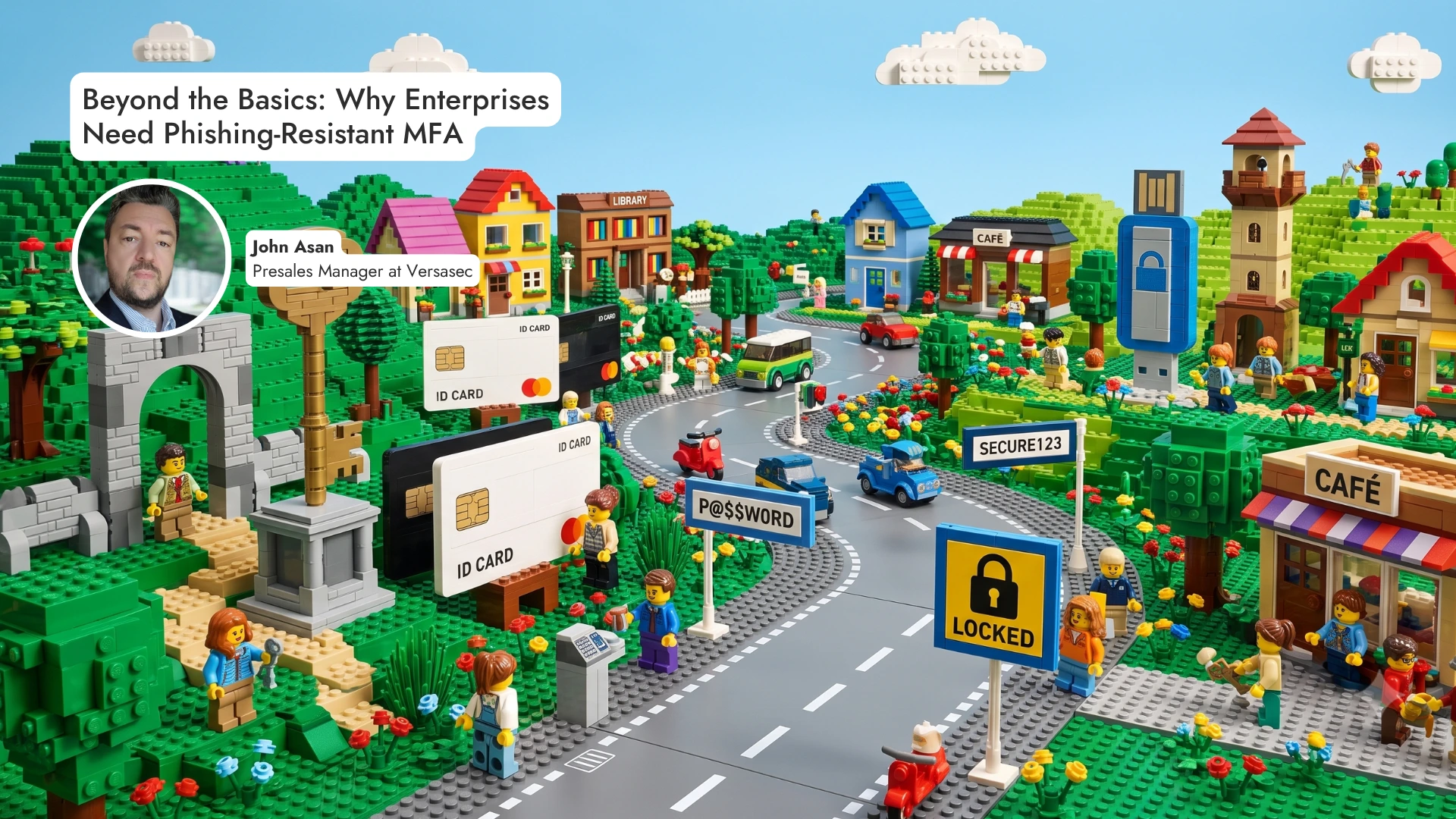
The cybersecurity landscape has fundamentally shifted. For years, basic Multi-Factor Authentication (MFA) methods, such as SMS codes and authenticator apps, successfully blocked opportunistic cyberattacks.
However, attackers are no longer just guessing passwords; they are actively bypassing basic MFA. Through tactics like Adversary-in-the-Middle (AiTM) proxy attacks, MFA fatigue (push bombing), and sophisticated social engineering, threat actors have proven that not all MFA is created equal. Securing modern organizations and protecting sensitive data now requires a transition to phishing-resistant MFA.
At its core, phishing-resistant MFA is an authentication method designed to ensure that even if a user is tricked into interacting with a malicious, look-alike website, their credentials cannot be compromised.
Traditional MFA relies on shared secrets, like a one-time password (OTP) sent via text or generated by an app. If a fraudulent login page is created, an unsuspecting user might input their credentials and the generated OTP, allowing an attacker to intercept the token and gain access to the real account.
Phishing-resistant MFA fundamentally breaks this attack chain. It eliminates shared secrets and relies on advanced cryptography and domain binding. The authentication token cryptographically verifies the origin of the login request. If the website is a deceptive clone, the hardware token will simply refuse to authenticate, even if the user attempts to approve the prompt.
The Gold Standards of Phishing Resistance
When discussing true phishing resistance, two primary technologies lead the industry, both of which utilize hardware-backed security:
1. FIDO2 / WebAuthn
The FIDO (Fast IDentity Online) standard uses public key cryptography to eliminate passwords entirely. Authentication occurs via a hardware security key, a biometric identifier, or a device-bound passkey. Because FIDO protocols require the authenticator to cryptographically verify the specific URL (domain binding) of the login page, an AiTM phishing proxy on a look-alike domain never receives a valid signature.
2. PKI and Certificate-Based Authentication (CBA)
Public Key Infrastructure (PKI) has been the gold standard for high-security environments, including government and defense sectors, for decades. Authentication relies on a digital certificate securely stored on a smart card or USB token. Since the authentication process does not require typing a password or an OTP, there is nothing for a phishing site to steal.
The Missing Link: Credential Management
Deciding to implement phishing-resistant MFA is only the first step. The true challenge for enterprise IT and security teams lies in deployment and lifecycle management.
Issuing a FIDO security key or a PKI smart card to a single user is simple. However, scaling that deployment to thousands of employees globally presents significant hurdles:
- Securely issuing tokens across distributed workforces.
- Managing remote, secure PIN resets.
- Replacing lost security keys efficiently.
- Immediately revoking certificates during employee offboarding.
Without a proper management system, the administrative overhead of hardware-backed MFA can easily overwhelm IT departments and helpdesks.
Bringing Order to Identity with a Credential Management System (CMS)
This is where a dedicated Credential Management System (CMS) becomes a foundational pillar of a Zero Trust architecture.
A solution like Versasec’s vSEC:CMS bridges the gap between physical security tokens (smart cards, FIDO keys, virtual smart cards) and identity providers (like Microsoft Entra ID or Okta). It automates the entire lifecycle of the credential, from issuance and deployment to revocation.
This matters because few organizations deploy just one of these technologies. PKI typically stays in place for legacy and high-assurance use cases while FIDO2 covers modern cloud applications, and managing each with a separate tool doubles the operational burden.
By utilizing a CMS, organizations can:
- Scale Phishing-Resistant MFA: Roll out FIDO and PKI credentials to thousands of users with automated, self-service workflows.
- Reduce Helpdesk Burden: Empower users to perform secure PIN resets and request replacement tokens without requiring an IT ticket.
- Ensure Compliance: Maintain a strict, centralized audit trail detailing who holds which credential, when it was issued, and what policies apply to it.
Upgrading to FIDO2 and PKI
Threat actors no longer hack in; they log in. Relying on phishable credentials leaves networks highly vulnerable to modern cybercriminals. Upgrading to phishing-resistant MFA, such as FIDO2 and PKI, is no longer just “best practice”; it is a structural necessity.
It is also where regulation is heading. The U.S. federal government has required phishing-resistant MFA across its agencies since OMB Memorandum M-22-09, and CISA guidance names FIDO2 and PKI as the methods to adopt.
Technology alone, however, isn’t enough. By pairing strong hardware authentication with an enterprise-grade Credential Management System, organizations can ensure that security upgrades do not create an administrative burden. For teams ready to streamline the identity lifecycle, exploring solutions like vSEC:CMS is the next critical step.
About Author

John Asan serves as a Presales Manager at Versasec, leveraging two decades of experience to deliver impactful IT strategies. His deep expertise encompasses identity and access management (IAM), cryptography, digital certificates, Public Key Infrastructure (PKI), Hardware Security Modules (HSMs), FIDO2 and user credentials. In his role, John excels at translating complex client requirements into actionable solutions. He collaborates closely with sales teams to understand prospect needs, and partners with the R&D division to architect customized IAM solutions that optimize business processes and enhance productivity.
vSEC:CMS
Our product suite provides all the software tools to administrate and manage credentials in a secure and convenient way.
Schedule a Strategic Call
Versasec provides enterprise credential management to accelerate phishing-resistant MFA. Our solutions enable customers to securely authenticate, issue and manage user credentials more cost effectively. Schedule a 1:1 Strategic Call With Our Identity Experts.
Job Openings
We are always looking for new exceptional persons to join our team! Find out more about our job openings.