
Navigating the Post-Quantum Shift: How to Migrate 50,000 PIV Smart Cards to Hybrid Cryptography Without Breaking Your Business
Date: 2026-07-29
Author: Jim Dickens, Sr. Product Manager for Authentication, Thales TCT
I have been in the high-assurance cryptography space since 1996, originally designing software for cryptographic devices and managing military-grade certifications for the US Federal government. Over the past three decades, I’ve seen security standards evolve, but nothing quite matches the sheer scale of the migration we are currently staring down: Post-Quantum Cryptography (PQC). This shift has taken on a massive new sense of urgency following the White House announcement in June 2026, outlining critical federal directives to secure national infrastructure against advanced cryptographic threats.
In my daily conversations with enterprise CISOs and agency IT directors, there’s a recurring, high-stakes question: “How do we migrate 50,000 high-assurance smart cards to post-quantum certificates without grinding our daily operations to a halt?”
Let me share my perspective on why this migration is a unique beast, and how a combination of dual-mode certificates, hardware-level realities, and modern credential orchestration is the only way forward.
Why PIV is Worth Saving (And Why It’s in Danger)
First, let’s address the elephant in the room: why don’t we just abandon physical smart cards and PIV (Personal Identity Verification) for simpler software authenticators?
As I often tell our partners, PIV, as defined by NIST and FIPS SP 201-3, is widely considered one of the strongest and most complete identity specifications in existence. It isn’t just a simple authentication protocol; it is an end-to-end identity lifecycle system. It binds in-person identity proofing, background checks, hardware-protected credential generation, and strictly audited Certificate Authorities (CAs) into a single, cohesive trust architecture.
For federal agencies and highly regulated commercial enterprises, PIV is the gold standard.
But this gold standard is facing an existential threat. Despite its architectural strength, the cryptographic foundation of today’s PIV is entirely vulnerable to future quantum attacks. Because current PIV cards rely on classical RSA and ECC algorithms, a cryptographically relevant quantum computer will be able to run Shor’s algorithm to derive cardholders’ private keys directly from their public certificates. Once an adversary can derive these private keys, the fundamental trust model of the card collapses. Attackers can bypass physical door access, forge digital signatures, and gain unauthorized entry into secure networks, rendering our strongest authentication system useless.
Even worse, the “Harvest Now, Decrypt Later” (HNDL) threat means adversaries are actively recording encrypted enterprise traffic today, waiting for the day they can decrypt it retrospectively. When Q-Day arrives, which the industry conservatively anticipates between 2029 and mid-2030, any historical authentication data or encrypted communications secured by classical PIV certificates will be completely exposed.
Smart Card Bottlenecks: Memory Limits
When NIST finalized its PQC algorithms, anchored by ML-KEM for key encapsulation and ML-DSA for digital signatures, many assumed we would simply issue new certificates and call it a day.
If only it were that simple.
As an engineer at heart, I look at the physical physics of the silicon. Traditional classical certificates are tiny. An RSA-2048 signature takes about 256 bytes of data. By contrast, an equivalent ML-DSA-65 quantum-safe signature requires a massive 3,293 bytes of data on the wire.
This introduces a massive bottleneck: smart card memory limits.
Many legacy PIV and smart card chipsets currently deployed across organizations possess highly restricted EEPROM or Flash memory allocations (often as low as 72 KB or 144 KB). They physically cannot hold or process the massive mathematical key sizes required by purely post-quantum algorithms. Furthermore, legacy operating systems and local middleware simply lack the libraries to parse this new math.
The Bridge: Dual-Signature Certificates
To prevent a massive, budget-crushing “hard cutover” in which 50,000 employees are locked out of their workstations on Monday morning, we must rely on Dual-Signature X.509 Certificates.
A dual-mode certificate contains both:
- A classical public key and signature (e.g., RSA-2048 or ECDSA ).
- A post-quantum public key and signature (e.g., ML-DSA-65 ).
If an employee logs into a legacy internal database or a domain controller that hasn’t been upgraded, the system simply ignores the unrecognized post-quantum extension and authenticates using the classical signature. If they log into a quantum-enabled gateway or cloud service, the updated server parses and verifies the post-quantum signature.
This dual-signature architecture ensures continuous, zero-downtime coexistence.
How to Orchestrate 50,000 Migrations
Even with dual-mode certificates, the logistics of updating 50,000 physical cards are daunting. You cannot ask 50,000 employees to mail their smart cards back to IT, nor can you expect your helpdesk to manually reprogram them one by one.
A successful migration requires a highly orchestrated, component-to-component integration across the entire PKI ecosystem.
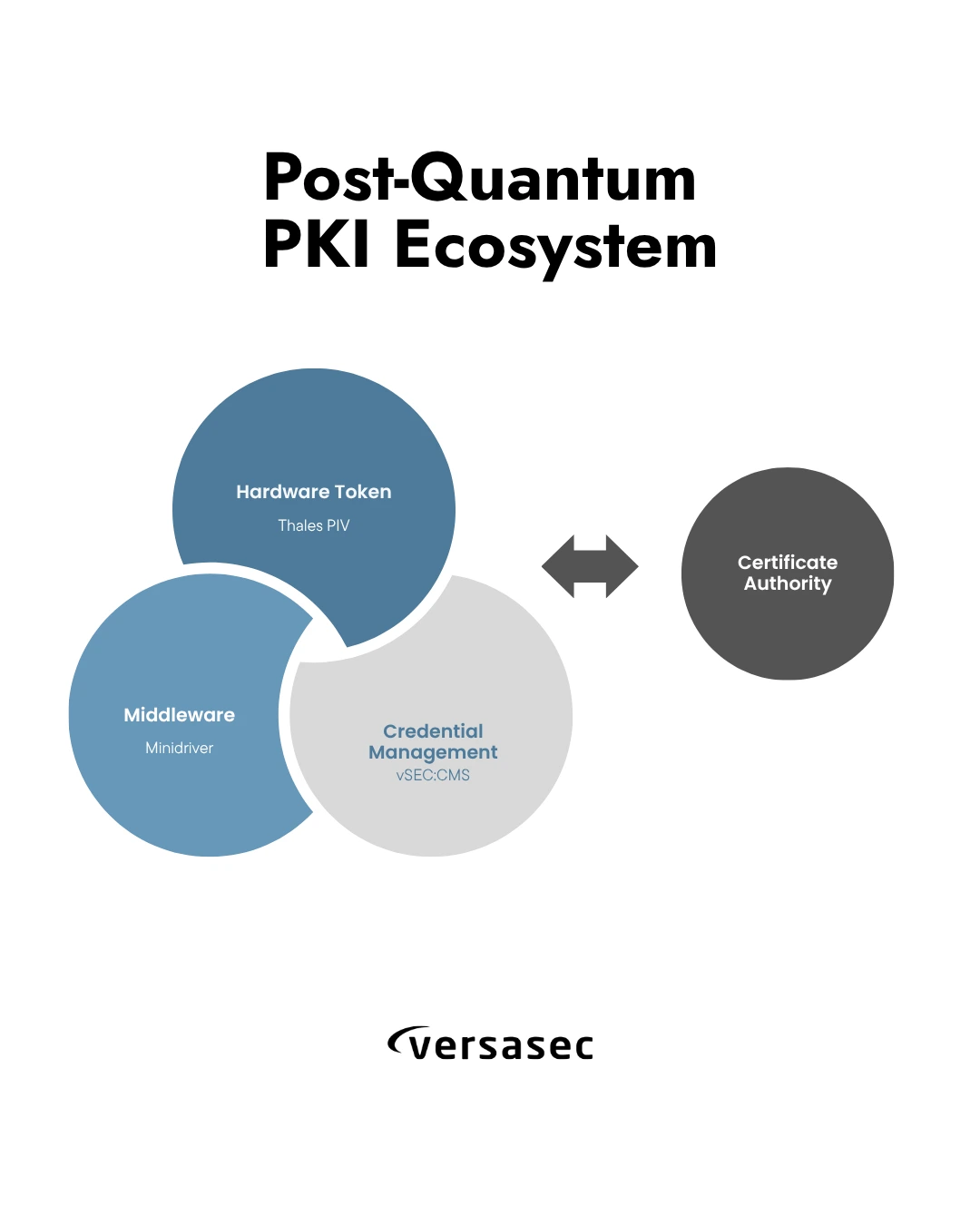
Here is the operational blueprint I recommend to organizations preparing for this transition, aligned with the looming US Federal PQC target dates (where dual-mode deployments must begin by 2028, leading to a target for full PQC migration by 2033):
1. Execute an Automated Cryptographic Discovery
Security starts with full asset visibility. Use your Credential Management System (CMS) to scan and inventory your entire distributed active fleet. You must classify every smart card in circulation by chip manufacturer, model, and firmware version. This allows you to immediately identify legacy tokens that must be targeted for physical hardware replacement before the migration.
2. Prepare the CA and Template Infrastructure
Coordinate with your Certificate Authorities. Your CMS must be integrated with dual-mode-capable CAs that have rebuilt their trust anchors with post-quantum-safe roots. Once the CA is ready, define the dual-signature credential templates within your CMS, ensuring the classical key occupies the default legacy container.
3. Deploy Silent, Automated In-Place Upgrades
The magic of a modern CMS (such as Versasec vSEC:CMS) is its ability to perform “silent background enrollment.” When an end-user inserts their smart card and enters their classic PIN to authenticate at their standard workstation, the CMS can initiate an automated background update script.
While the user is working uninterrupted, the system securely communicates with the CA, generates the secondary ML-DSA keys directly inside the card’s secure hardware element, and registers the new dual-signature certificate. If a network disruption occurs mid-transaction, the CMS safely rolls back to the classical profile, preventing lockouts.
Final Thoughts: A Successful Transition
At Thales TCT, we build the physically secure silicon, and Certificate Authorities generate the complex math. But ultimately, a successful post-quantum transition relies entirely on the component-to-component integration of these systems.
Credential Management Systems like Versasec vSEC:CMS act as the operational glue. They translate raw cryptographic readiness into automated, frictionless user workflows.
The quantum threat is no longer a distant academic debate. With compliance deadlines narrowing and adversaries archiving your data today, the time to design, test, and orchestrate your dual-mode migration is now. Don’t wait until Q-Day to find out your hardware can’t handle the load.
About the Author
Jim Dickens is a Senior Product Manager and Program Manager at Thales Trusted Cyber Technologies (TCT). He specializes in delivering mission-critical security solutions for US Federal customers, overseeing the company’s authentication, high-speed encryption, and third-party product lines. In addition to guiding product strategy, Jim manages key Thales TCT programs and their associated federal contracts to ensure secure, compliant outcomes for government agencies.
vSEC:CMS
Our product suite provides all the software tools to administrate and manage credentials in a secure and convenient way.
Schedule a Strategic Call
Versasec provides enterprise credential management to accelerate phishing-resistant MFA. Our solutions enable customers to securely authenticate, issue and manage user credentials more cost effectively. Schedule a 1:1 Strategic Call With Our Identity Experts.
Job Openings
We are always looking for new exceptional persons to join our team! Find out more about our job openings.